Why small island states must invent
Distance, smallness, the cyclone belt, the Pacific Ring of Fire and a narrow tax base are not policy failures — they are geography. This page explains the arithmetic that makes ordinary taxation insufficient for states like Vanuatu, and why creating non-tax revenue is not a luxury but a survival strategy.
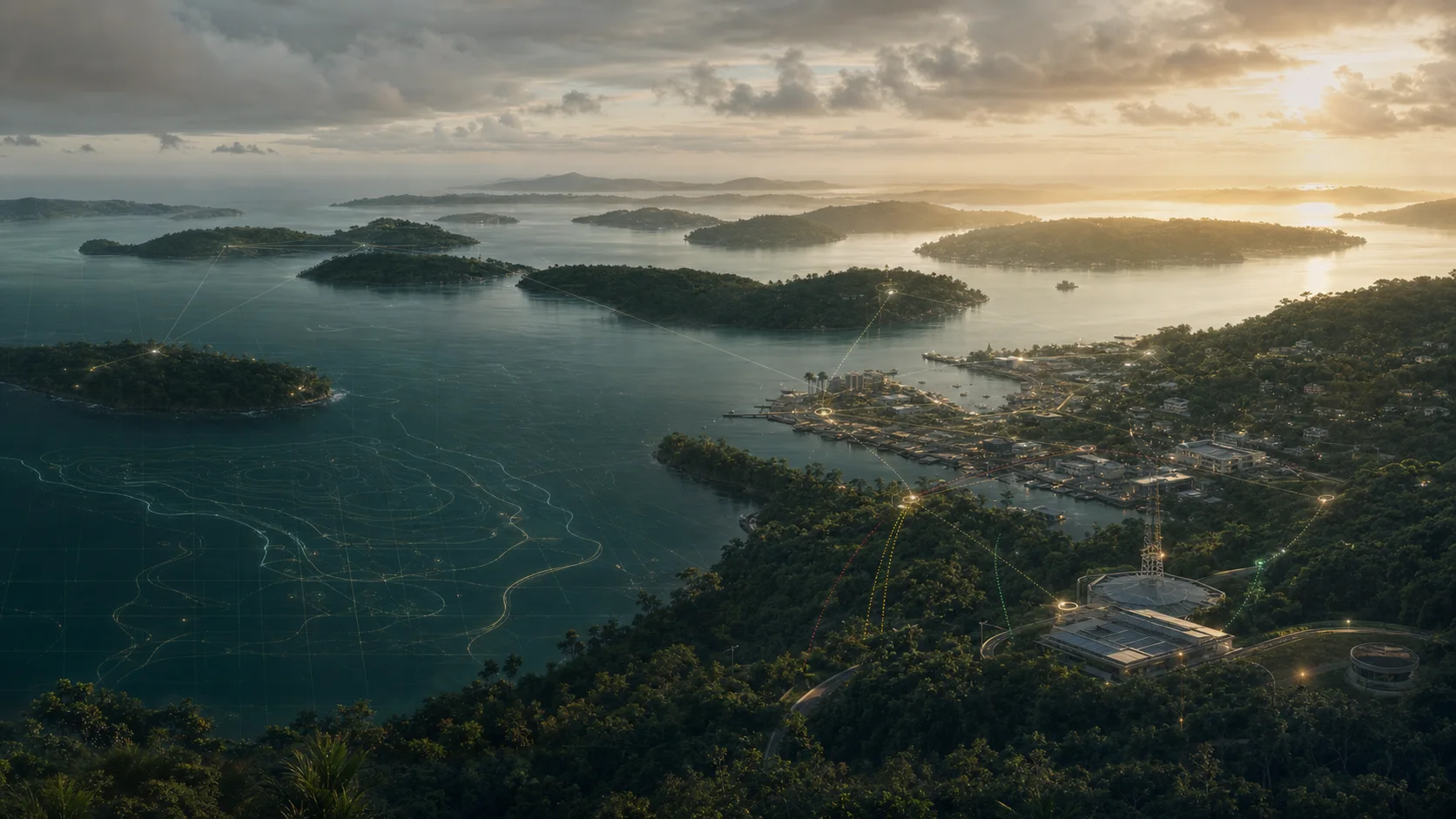
Four constraints no policy can repeal
Every small island developing state lives with the same four facts. They cannot be legislated away — they can only be answered.
Remote by geography
Thousands of kilometres from major markets, with some of the highest transport and trade costs on earth. The scale economies continental states take for granted simply do not exist here.
Small by population
Around three hundred thousand people — a tax base smaller than one district of a large city, carrying every function of a modern state: diplomacy, customs, courts, schools, hospitals.
Cyclones, earthquakes, volcanoes
Vanuatu sits where the South Pacific cyclone belt crosses the Ring of Fire: Category-5 storms, magnitude-7 earthquakes and active volcanoes share the same decade. The World Risk Index has repeatedly ranked Vanuatu the most disaster-exposed nation on earth.
A narrow revenue base
Tourism receipts, import duties and aid — each volatile, none of them decided in Port Vila. The budget rises and falls with forces the nation does not control.
The calculation large economies rarely see
In a country of fifty million taxpayers, one point of tax is a budget instrument. In an archipelago of three hundred thousand people, it is neither meaningful revenue nor a harmless lever: the same adjustment raises little — and what little it raises, it takes from a private sector already carrying the world’s highest costs of distance.
This is the part that developed economies — built on deep tax bases, dense markets and connected geography — find hardest to see: for a small island state, “just tax more” is not a plan. The running costs of a state do not shrink with population, but the base that must carry them does. The gap has to be closed from outside the tax system — or it does not close at all.
And this is not a hypothesis. It is the nation’s lived ledger of a single decade:

| Year | Event | What it took |
|---|---|---|
| 2015 | Cyclone Pam — Category 5 | Damage and losses near two-thirds of GDP; around 65,000 people displaced |
| 2017–18 | Ambae (Manaro Voui) eruptions | An entire island evacuated — about 11,000 people, twice |
| 2023 | Cyclones Judy & Kevin — twin Category 4s, 48 hours apart | Around four in five Ni-Vanuatu affected |
| 2024 | Port Vila earthquake — magnitude 7.3 | Direct damage near a fifth of GDP; the international submarine cable severed |
Figures from official post-disaster assessments by the Government of Vanuatu and international partners, including the World Bank’s rapid damage estimate (2025).
Each event cut national income at the exact moment costs surged — and every recovery was financed from the same narrow base the disaster had just damaged. That is the cycle this programme’s revenue is designed to break.
From constraint to invention: non-tax revenue
What a small island state lacks in taxpayers, it possesses in something rarer: full sovereignty — the lawful power to confer status, identity, registration and standing that the wider world values. Delivered digitally and to international standards, those services become national income that does not depend on the weather, the harvest or the flight schedule.
That is the innovation at the heart of this programme: not a new tax, but a new column on the national ledger. Estonia showed a small state could earn from digital trust; Palau carried the idea into the Pacific; Vanuatu’s National Bureau is the first attempt to legislate the complete model — integrity rules, independent oversight and a citizenship firewall included — so the income is durable and the nation’s name is protected.
Resilience is engineered in, not assumed: the registries are digital, kept to international standards and built for redundancy — so the nation’s records and revenue survive what buildings sometimes cannot. When the 2024 earthquake severed the country’s submarine cable, it settled the design argument: critical national systems must not depend on one island, one line or one season.
The first complete, legislated model
What this page describes in principle, the rest of this website describes in practice:
Read the full case
Eight pages, in order — from the institution to the application.